Understanding Financial Time Series Models (Part V):The Fama-French Three-Factor Model
Chen Quant Academy Series -- Introducing Quantitative Models in Finance
In the previous articles, we explored how quantitative models can help us understand the dynamics of financial markets:
-
ARMA: How do past returns and shocks shape today's expected return?
-
ARCH: How do past shocks influence today's uncertainty?
-
GARCH: How does uncertainty itself evolve over time?
-
VaR: How can we translate market uncertainty into a measurable potential loss?
So far, the focus has been primarily on time-series behavior and risk measurement.
We now turn to another fundamental question in finance:
Why do different assets earn different expected returns?
Why have small companies sometimes generated different returns from large companies? Why have value stocks historically behaved differently from growth stocks? And can the risk of a diversified portfolio really be summarized by a single number such as market beta?
These questions led to one of the most influential developments in modern asset pricing: the Fama-French Three-Factor Model.
Introduce Fama-French
From CAPM to the Fama-French Model
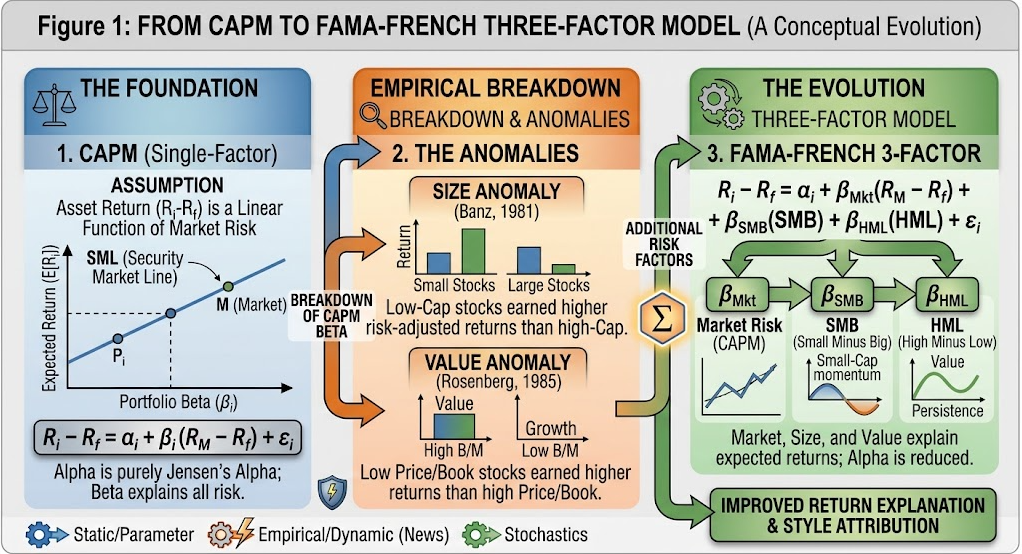
Before introducing the Fama-French model, it is useful to review the Capital Asset Pricing Model (CAPM).
The CAPM argues that the expected excess return of an asset depends primarily on its exposure to market risk:
- : Return of asset i
- : Risk-free rate
- : Market portfolio return
- : Sensitivity of the asset to movements in the overall market
The intuition is straightforward.
If an asset tends to move strongly with the market, investors are exposed to greater systematic market risk. Therefore, they may demand a higher expected return as compensation.
CAPM was a major breakthrough because it separated risk into two categories:
-
Systematic risk: Risk associated with the overall market
-
Idiosyncratic risk: Firm-specific risk that can potentially be diversified away
However, empirical research gradually revealed an important problem.
Market beta alone could not fully explain differences in average stock returns.
Researchers observed persistent patterns associated with characteristics such as:
-
Company size
-
Valuation ratios
-
Book-to-market ratios
These patterns became known as factor anomalies or return anomalies.
This motivated Eugene Fama and Kenneth French to propose a broader framework.
The Fama-French Three-Factor Model
In 1993, Eugene Fama and Kenneth French introduced the Fama-French Three-Factor Model.
The model extends CAPM by adding two additional factors to the traditional market factor-- Size Factor and Value Factor.
The model can be written as:
The model attempts to explain an asset's excess return using its exposure to these three systematic factors.
- SMB: Small Minus Big, the size factor
- HML: High Minus Low, the value factor
- : Abnormal return not explained by the three factors
- : Residual or unexplained component
The central idea is:
A stock's return may depend not only on its exposure to the overall market, but also on its exposure to systematic patterns associated with company size and relative valuation.
Factor One: The Market Risk Premium
The first factor is inherited directly from CAPM:
This represents the market excess return, or market risk premium.
It measures the additional return investors receive from holding the market portfolio instead of a risk-free asset. Each asset has a market beta: . A stock with a beta greater than 1 tends to move more strongly than the overall market. The market factor captures broad systematic economic and financial risk.
However, the Fama-French research suggested that market exposure alone was not enough.
Factor Two: SMB --- The Size Factor
The second factor is SMB, stands for Small Minus Big. It measures the return difference between portfolios of small-cap stocks and large-cap stocks:
A positive SMB return means that, during that period, small companies outperformed large companies, negative value means that large companies outperformed small companies.
The size factor was motivated by the observation that smaller companies historically appeared to exhibit different average return behavior from larger companies.
In the Fama-French framework, an asset can also have an estimated SMB factor loading, . A positive indicates that the asset's returns tend to move with the SMB factor, while a negative indicates an opposite relationship.
Importantly, does not classify a company as small or large. Company size is used when constructing the SMB factor; is subsequently estimated from the asset's return relationship with that factor.
Factor Three: HML --- The Value Factor
The third factor is HML, it stands for High Minus Low. It measures the difference in returns between stocks with high book-to-market ratios and low book-to-market ratios.
An asset's exposure to the value factor is represented by . A positive indicates that its returns tend to move with the HML factor, while a negative indicates an opposite relationship. This factor exposure should not be confused with directly classifying the asset as a value or growth stock.
How Are SMB and HML Constructed?
One of the strengths of the Fama-French framework is that its factors are constructed from portfolios of real stocks rather than treated as abstract theoretical variables.
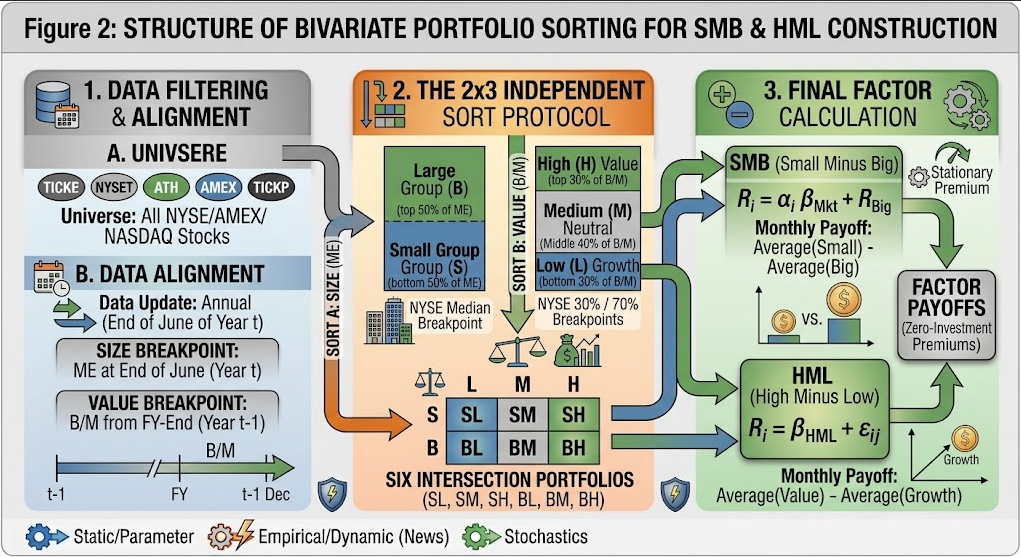
At the end of each June, U.S. stocks are sorted independently by market capitalization and book-to-market ratio (B/M). The size breakpoint is the NYSE median market capitalization, while the B/M breakpoints are the 30th and 70th NYSE percentiles.
These two classifications create six value-weighted portfolios: Small/Value, Small/Neutral, Small/Growth, Big/Value, Big/Neutral, and Big/Growth. The portfolios are then used to construct the factor returns.
This construction transforms observable company characteristics into portfolio-based systematic factors.
Why Do These Factors Matter?
Why should small-cap and high-value firms earn systematic return premia over long horizons? Academic finance is divided into two competing schools of thought:
1. The Rational Risk-Based Hypothesis (Fama & French)
Under the Efficient Market Hypothesis (EMH), higher returns can only stem from higher systematic risk:
-
Size as Vulnerability: Small firms have less diversified revenue streams, limited access to debt capital markets during recessions, thinner trading liquidity, and higher default sensitivities to aggregate macroeconomic contractions.
-
Value as Relative Distress: High B/M firms are typically mature companies experiencing prolonged financial distress, depressed earnings, or high financial/operating leverage. Their capital equipment is often irreversible, making them unable to easily downscale during market downturns.
-
Covariance with State Variables: In line with Robert Merton's Intertemporal CAPM (ICAPM), size and value act as state variables tracking shifts in investment opportunities, labor income risks, and credit availability.
2. The Behavioral Finance Hypothesis (Lakonishok, Shleifer, and Vishny)
Behavioral economists argue that factor premia are manifestations of persistent cognitive biases:
-
Extrapolation Errors: Investors irrationally extrapolate the recent strong earnings growth of "glamour" (low B/M) stocks too far into the future, bidding their prices above intrinsic value.
-
Overreaction to Adversity: Investors excessively punish unglamorous value companies experiencing short-term setbacks. When value firms subsequently exhibit modest mean-reversion in profitability, they generate positive earnings surprises, yielding the value premium.
-
Limits to Arbitrage: Institutional career risk (fund managers avoiding distressed stocks that look risky to clients) prevents smart money from fully arbitraging away these pricing discrepancies.
The Fama-French model primarily provides a framework for measuring and modeling factor exposure; it does not by itself settle the debate over why these premiums exist.
What Does the Three-Factor Model Explain?
Suppose we analyze a stock portfolio and estimate its . Its returns may be partially explained by its exposure to market movements, Small/Large-company performance, and Value/Growth-stock performance.
After controlling for market, size, and value exposures, we examine: . If a portfolio's returns are fully explained by factor exposures, its estimated alpha may be close to zero. If a statistically significant positive alpha remains, this may suggest performance not fully explained by the three factors.
Therefore, the Fama-French model became an important tool for portfolio performance evaluation , fund manager analysis , risk decomposition , benchmark construction , and factor investing .
Alpha: Skill or Factor Exposure?
One of the most important applications of factor models is separating Investment skill from systematic exposure. Suppose two portfolios both generate a 12% annual return. At first glance, they appear equally successful. However, after factor analysis, we may discover Portfolio A with High market beta and Alpha close to zero , while Portfolio B with Moderate factor exposure and Positive and statistically significant alpha.
These portfolios may have produced the same return, but the sources of that return are very different. Portfolio A may have simply taken systematic factor risks, and Portfolio B generated returns that are not statistically explained by the factors included in the model.
This distinction is central to modern portfolio analysis. High returns do not automatically imply high investment skill. A return must be evaluated relative to the risks and systematic factors that generated it.
The Connection to Modern Quantitative Investing
The Fama-French model helped transform the way investors think about portfolios.
Instead of viewing a portfolio only as a collection of individual stocks, quantitative investors increasingly analyze portfolios as collections of factor exposures. The Fama-French Three-Factor Model was one of the most important frameworks that helped establish this approach.
Practical Applications
Performance Attribution & Active Manager Analysis
A manager may appear to generate substantial alpha when evaluated against a simple benchmark such as CAPM. After controlling for size and value exposures, however, the estimated alpha may become substantially smaller or statistically insignificant.
The analysis can therefore reveal whether apparent active performance is partly explained by systematic factor exposures.
Corporate Hurdle Rates & Cost of Equity
Under multi-factor models, the cost of equity for corporate capital budgeting expands beyond CAPM.
Multi-factor models can produce different estimates of required return from CAPM when an asset has significant exposure to additional systematic factors such as size and value.
Quantitative Factor Investing and Style Neutralization
Investors can intentionally construct portfolios with desired exposures, or employ Fama--French factor loadings to ensure their portfolios are factor-neutral.
Investing with desired exposure is known as factor investing. Instead of selecting individual stocks based solely on company-specific forecasts, investors can manage portfolios according to systematic factor characteristics.
If a quant signals mispricing based on earnings momentum, they can construct their portfolio to neutralize portfolio SMB and HML coefficients. This can help investors distinguish a portfolio's intended alpha signal from unintended exposure to systematic size and value factors.
Limitations of the Fama-French Three-Factor Model
Although the model significantly boosted explanatory power and is extremely influential, it does not explain all return patterns.
1. Momentum Is Not Included
One of the most important return patterns in financial markets is momentum. Stocks that have performed well over certain past periods have historically shown a tendency, under some conditions, to continue performing well in subsequent periods.
2. The Model May Omit Other Important Factors
Later research identified additional factors related to Profitability, Investment behavior, Momentum, Liquidity, Quality etc. These developments eventually led Fama and French to propose the Five-Factor Model.
3. Alpha Depends on the Model
This is a particularly important limitation. A portfolio's alpha depends on which factors are included in the model. A manager may appear to generate positive alpha under CAPM. After adding size and value factors, that alpha may decrease. After adding momentum and other factors, it may decrease further. Therefore: Alpha is not an absolute concept. It is always measured relative to a model.
Summary
The previous articles in this series focused primarily on understanding and measuring financial risk:
ARMA → ARCH → GARCH → VaR
These models asked: How do returns evolve? How does volatility evolve? How can potential losses be measured?
The Fama-French model introduces a different by asking which systematic factors may help explain a portfolio's returns. It extends the traditional CAPM framework by recognizing that stock returns may be related to more than market exposure alone. The key insight is:
Investment returns should not be evaluated only by how much a portfolio earned, but also by understanding which systematic factors generated those returns.
This idea fundamentally influenced modern portfolio management, quantitative investing, and performance evaluation.
Looking Ahead: Beyond Three Factors
The Three-Factor Model represented a major step forward in asset pricing, but financial markets are more complex than three sources of systematic risk.
In the next article, we will introduce the Fama-French Five-Factor Model and examine how profitability and investment extend the three-factor framework.